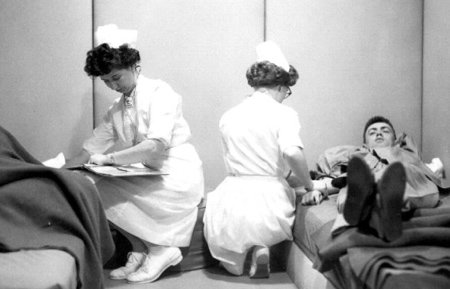
There were many acid tests happening in the 1950s and 1960s. Ken Kesey and his Merry Pranksters dosed sometimes-unsuspecting proto-hippies. The CIA was dosing unsuspecting mainstreamers. Leary dosed fully cognizant artists, therapists and students. But meanwhile, over at Army Chemical Center at Edgewood Arsenal in Maryland, psychiatrist James S. Ketchum was testing LSD, BZ and other psychedelic and deliriant compounds on fully informed volunteers for the U.S. military.
As an Army psychiatrist just out of residency, Dr. James E. Ketchum was assigned to Edgewoord Arsenal's Medical Research Laboratories, first as a research psychiatrist in 1961. He became Chief of the Psychopharmacology Branch in 1963, and then became Acting Chief of Clinical Research in 1966. After a brief hiatus at Stanford University, he returned as Edgewoods' Chief of Clinical Research in 1968, staying there until 1971. Dr. Ketchum and his team were looking, primarily, for non-lethal incapacitating agents, and he was central to many of the experiments with these compounds that took place during that time.
Now, Dr. Ketchum has released his fascinating self-published memoir, Chemical Warfare: Secrets Almost Forgotten, primarily detailing his times at Edgewood. The book boasts charts, graphs and experimental reports — a veritable goldmine of information for those who are interested in psychedelics, deliriants, or chemical warfare. It's also a funny, observant, and reflective personal memoir, casting a light not only on Ketchum and his work, but on a decade that saw 60s counterculture and the military share an oddly intersecting obsession with mind-altering drugs.
Dr. Ketchum himself has remained intrigued by these chemicals, as reflected in his ongoing friendship with Dr. Alexander (Sasha) Shulgin, who wrote a foreword for this book.
I recently interviewed him for The RU Sirius Show. Steve Robles joined me.
To listen the full interview in MP3, click here.
RU SIRIUS: Tell us about the research you did at Edgewood Arsenal with various substances as weapons. What was the political environment?
JAMES KETCHUM: It was during the Cold War and there was great concern about what the Soviet Union might be plotting. It was known that they were investing a lot of money in chemical warfare research — about ten times as much as we were. And at the same time, there was an interest in the U.S. in developing weapons that might be called more "humane" as opposed to "conventional" weapons. In 1955, Congress was entertained by Major General Creasy, who described what LSD could do. At the time, that was the latest drug of interest. And as he described it to Congress, they became very enthusiastic, and voted in favor of doing research into LSD as a possible incapacitating agent that would be life-sparing. Congress passed a resolution with only one vote against it, which is perhaps indicative of the philosophy of the times.
So money was allocated to build a project at Edgewood Arsenal, the army chemical center. And over the next few years the budgeting increased, supported by John F. Kennedy, among others. I was given the opportunity to go there after my residency in psychiatry in 1961, and I thought it would be interesting. I ended up spending about ten years there. When I arrived, the program was just in its nascency. There had been some work done by others there with LSD, but they had never had a psychiatrist. And they'd run into a few problems that made them think they ought to have one. So I was given pretty much a free hand over the next few years to develop a program that would be safe and also provide the information that was being sought, not only about LSD but about drugs like BZ, and others.
RU: So you actually ended up having a long strange trip of your own. You had some very interesting experiences with it.
JK: I enjoyed it very much. Unfortunately at the time, classification of that research was so great that very little of the information we found was leaked out to the public or allowed to be spread among the public. And as is the custom in the army — or was the custom — classified papers usually remained classified for 12 years before they'd be downgraded and made available. By that time, most people had gone separate ways. The program itself had been pretty much terminated. No one really wrote the history of that decade. I thought, later, that was a serious omission. And that's what led me to write this book.
STEVE ROBLES: Did you find any evidence that the Soviets might have taken this tack in their own chemical warfare research?
JK: There was information indicating that, around 1960, the Soviet Union was importing vast quantities of contaminated rye from the satellite countries. This was interpreted as being indicative of their interest in producing LSD, since there's not much use for contaminated rye except that it contains ergot, which is a form of contamination [ed: ergot is used to prepare lysergic acid, the raw material for LSD]. That made us think maybe they were having a big LSD development program of their own.
SR: So there was a different kind of space race going on at the same time.
JK: That's right. Inner space.
RU: The meat of this book, and the fun part, is descriptions of people undergoing the experiments. I wonder if any moments in particular pop into your head showing the way that human beings behave under the influence.

JK: I watched a number of people — actually, more than a hundred — going through the experience of having BZ, which is a long-acting atropine type compound. It produces delirium if given in a sufficient dose. Half-a-milligram is sufficient in the case of BZ, as compared with about 10 milligrams of atropine. To describe the tripping in detail would take some time. In the book, I've documented an entire BZ trip over a hundred-hour period, including everything that was said and done.
RU: You had a man watching an entire football game on his fingernail or something?
JK: It was a tiny baseball game on the padded floor. The hallucinations were "real" hallucinations. I'd like to make a distinction between BZ hallucinations and LSD so-called hallucinations, which are really not hallucinations — they're more illusions. People generally know that they're not real, but produced by the drug. Whereas with BZ, the individual becomes delirious, and in that state is unable to distinguish fantasy from reality, and may see, for instance, strips of bacon along the edge of the floor.
RU: Belladonna would probably be the most common deliriant among drug experimenters.
JK: Right. Loco weed. Belladonna, in the form of Asmador, for example, was used for asthma and contains atropine. People were getting high on this in the 60s. My brother described one young man trying to crawl across a street in New York City and grabbing onto the pants leg of a police officer. People don't know what they're doing when they're under the influence. They mistake people for objects and objects for people. They'll salute the water fountain or bump into a nurse and say, "Excuse me, sir," and the like.
RU: Were you guys doing a lot of chuckling while this was going on? You're trying to maintain a certain degree of decorum, but...
JK: Yes. I would tell the technicians that it wasn't nice to laugh at these things, even though the subject probably wouldn't remember it later. It was sometimes hard to suppress it. Like when one individual asked another, in the same padded room, if he could have a cigarette. And then, when the other individual held out an empty hand that looked like it was holding a pack, he said, "Oh, I don't want to take your last one." So it was fully "out there" on a fantastic scale.
RU: I had a friend who took belladonna at a rock concert. And about halfway into it, he thought he was back in his own room and that the music on the radio really sucked, and he was going to turn it off. That basically involved twisting this girl's kneecap until he got kicked out. Fortunately, it was just the kneecap.
JK: One young man tried to straighten out my arm, as if it were a pipe of some sort! He tugged on it, and pulled it, and didn't seem at all aware that I might be discomforted by that.
RU: So this book, which is about a very serious subject, is actually quite an amusing read.
JK: Yeah, I tried to keep it from being too heavy, and included a number of anecdotes about people who weren't delirious that were equally funny.
RU: Some of the inter-office activity was amusing too. Describe what happens when soldiers try to deal with mock-up battle conditions under the influence of BZ.
JK: Well of course, commanders wanted to know what would happen if this stuff were ever used in the field. So at first we set up an indoor type of situation, a sort of simulated command post with four soldiers in it. One of them was given a full dose of BZ while the others were given either small doses or none at all, in order to have some possibility of maintaining order. So this one individual would continually go to the door and try to get out. He'd turn around and say, "I'll see you later," but it was locked, and he finally concluded that he was trapped. When the cameras, which were behind these sliding plywood doors, were opened, he came over to one and looked into it as if it were the eye of a Martian. And then he tried to climb out through the medicine cabinet. Then he went over to the water bag and yelled, "Hey, this broad just committed suicide." It took quite a bit of help from his teammates to keep him from hurting himself. But fortunately, nothing serious happened.
RU: You write that nobody was really injured or permanently damaged by these experiments, and you make a distinction between the work that you did at the arsenal and work done by the Central Intelligence Agency.
JK: I tried to dissect out the work done by the army from the work done by the CIA. The CIA, of course, was the first to undertake studies of LSD. They did it without any real scientific structure; and they took liberties that they shouldn't have taken, giving it covertly to American citizens and the like. This was the MK-ULTRA program. Unfortunately, Edgewood Arsenal acquired a reputation for being somehow involved in the MK-ULTRA program — being somehow underwritten by the CIA. And this was not true. There were a couple of individuals who had a secret connection to the CIA, but the program itself was transparent, at least within the military, and there was none of the hijinx that the CIA carried out in San Francisco and other places. [ed: they gave LSD to customers in a house used for prostitution and watched them through a two-way mirror.]
RU: You recently gave testimony about the CIA program. Tell us a little bit about that.
JK: I testified on behalf of Wayne Ritchie, a deputy U.S. Marshall who had been an ideal officer — four years in the Marines, a year at Alcatraz as a guard. He was regarded as perfectly stable — normal. After a Christmas party, where people from the CIA office next door were present, he came back to his office and began to believe that everyone was against him. And then he went out on the street and walked home for the first time without his car, and was convinced that his girlfriend was against him; and the bartender was against him. So he decided to hold up a bar and get enough money for his girlfriend to fly to New York, and then he'd be arrested and they would kick him out of the US Marshal Service and everyone would be happy. So this is what he did, and this is what happened. And when he came to and realized what he'd done, he felt terrible. He wanted to commit suicide. He asked for a bullet to save the state some money, and he submitted a letter of resignation.
From that point on, he was regarded as a pariah and he spent the rest of his life believing he had committed a serious crime for which he'd never be forgiven. Then Sidney Gottleib — who was the head of the MK-ULTRA program — died. And in his obituary, it mentioned that he was supervising the administration of LSD to unwitting American citizens. [ed: The CIA also dosed unsuspecting attendants at office parties, as documented in Acid Dreams and elsewhere.] And so the light went on in his head at that point, and Wayne realized, or believed, that that's probably what happened to him. So a case was eventually brought to court, and I was asked to testify on behalf of Wayne. I spent two-and-a-half days on the witness stand, mostly answering questions from CIA lawyers. Ultimately the outcome was not favorable, unfortunately. The judge didn't feel convinced, and neither did the Appeals court. The judge said, in effect, "If you can explain this man's criminal behavior with LSD, then I suppose you could blame anyone's criminal behavior on LSD." And this really wasn't very logical and didn't fit the facts, but that's how it ended up. It was a rather unhappy ending to an unhappy story.

RU: A number of your volunteers in the LSD experiments expressed feelings of having had a profound experience. More frequently than not, they expressed a sort of regret in coming down and having the experience end.
JK: Yes. We were primarily interested in measuring performance on a systematic basis. But, of course, clinically it was pretty hard to ignore the differences in the responses to LSD that we observed. Some individuals would become very frolicsome and laugh a great deal. Some would become depressed and withdrawn; some became paranoid. Seeing the spectrum of responses in otherwise normal young men was quite interesting. One individual in particular, I believe, actually had a therapeutic experience. He was in a group of four, and we held a televised discussion after the test, and he admitted finally under pressure from his buddies that he had had some unacceptable erotic thoughts about the nurses that he was reluctant to reveal. And they told him that was all right, there's nothing wrong with that. And when he went back to his unit, I heard indirectly that his personality was different. He became more sociable and outgoing. I have to give LSD some of the credit in that case.
RU: Also a frequent response from some of the volunteers was to find the tests just silly and absurd and to just laugh at the things they were asked to do.
JK: Yeah, under LSD, they perceived the absurdity of being asked to solve as many arithmetic problems as they could in three minutes. Sometimes they refused to do it all together. But in other cases they did their best, but couldn't do as well as they did before the drug. I took it once and I had precisely the same difficulty solving arithmetic problems, but I didn't have any of the wonderful visions and fantasies. I guess because I was thinking of the psychopharmacology of the LSD going through my raphe nucleus and so forth.
RU: You took 80 micrograms. It's a little bit shy of a trip.
JK: Yeah. But it was chemically pure, U.S. Army-grade, 99.9 percent...
RU: Got any of that stuff left?
JK: Well, there was 40 pounds left in my office one day in a big black barrel...
RU: Oh yes! Do tell the story of the canister.
JK: I was chief of the department at that point. When I came into work one day, I noticed that there was a big, black, sort of oil barrel-type drum in the corner of the room. And no one said anything, or told me anything about it. So after a couple of days, my curiosity overcame me. After everyone had gone home, I opened it up and pulled out a jar. And I looked and saw that it was about 3.41623 kilograms of LSD. And so were the rest of the jars.
RU: Drop that baby on Iran and see what happens.
JK: But after another couple of days, the barrel was gone! I never heard anything; I never got a receipt for it. The LSD there was probably worth about a billion dollars on the street. And it just stayed there for a few days and went away.
SR: Speaking of getting onto the street, I've never heard of BZ, I guess it didn't penetrate the black market?
RU: That's really not the sort of thing people tend to want to take.
JK: Well, as I say, it's similar to atropine or belladonna, which some people have taken for trips, and it's been used through the ages for ceremonial purposes, for various purposes.
RU: I remember Durk Pearson saying it was interesting.
JK: It lasts about 72 hours in a dose that is just sufficient to incapacitate someone. It can last longer if you take more, but we kept the doses as low as we could. Delirium is not something that anyone particularly wants to go through. It's more of a shipment than a trip, I would say.
RU: You don't remember much. It's probably more fun to watch other people take it.
JK: Right. Not too much intelligent insight emerges under its effects.
RU: Let's get back to the purpose of this research. What you were hoping for?
JK: I felt I was working on a noble cause because the purpose of this research was to find something that would be an alternative to bombs and bullets. It could also be helpful in reducing civilian casualties, which have increased ever since the Civil War from almost zero percent to the eighty percent now or maybe higher — 90 percent perhaps in Iraq, because you can't really avoid "collateral damage" if the enemy is going to hide among the civilians. Perhaps it's a good time to rethink our use of incapacitating agents as a humane alternative.
The Russians did very well with this. When the Chechnyan terrorists took over an auditorium filled with attendees at a Moscow concert and held them captive for three days, the Russians brought in an incapacitating agent. It happened to be a morphine derivative of high potency, and they pumped it in through the ceiling and the floor, waited for a while, and then rushed in. And those terrorists did not detonate the bombs they had strapped to their bodies; they did not fire their weapons; they were all down on the floor unconscious, as was most of the audience. They were able to save about 80% of the audience.
RU: Do you feel that maybe they could've used a better incapacitating agent that would've allowed them to save everybody or nearly everybody?
JK: No, I don't think there was anything better they could've used. This was a quick-acting drug, which is what it had to be. If they'd used BZ or some drug like that, the effects would have come on too gradually. The terrorists would have had time to figure out what was going on. So this was a knockout effect, and it worked very well. And I credit the Russians for doing this, although they seem to be embarrassed about giving out the details, because in the United States and the rest of the world in general, chemical warfare in any form is a no-no.
RU: It's illegal internationally, isn't it?
JK: A number of treaties were drawn up, the last of which was the chemical warfare convention. And it's now illegal to use any drug that can either cause death or seriously disturbed behavior. And I think it's unfortunate that we went in and agreed to this treaty because we're now in a different kind of war from anything we've been in previously.
SR: I wonder what effect of LSD would have in either dislodging — or maybe even reinforcing — the beliefs of real serious believers, like fanatical Islamists, for example.
JK: Well, LSD was discarded pretty early on as an incapacitating agent when it was realized that it produced highly unpredictable effects and that people could still retain the ability to fire a rifle or push a button on a bomb-release mechanism. So I'm pretty sure LSD would not be used. It would have to be something in the opiate category, like what was used in Moscow; or perhaps one of the rapid-acting belladonna-like drugs. Incidentally, although BZ was adopted briefly and even packed into munitions, as far as I know, it was never used, despite rumors to the contrary. And later on we found rapid-acting compounds in the same category — short-acting, rapid-acting compounds that would've worked much better. But by this time, the whole notion of militarizing incapacitating agents had lost its window of opportunity. That's one reason that all this research was kind of left in file cabinets.
RU: We've talked about psychedelics, and we've talked about deliriants. But what about disassociatives like ketamine and PCP? Do those hold any potential in your opinion, and do you know if they were looked into at all?
JK: A little work was done with PCP before my arrival. They had a complication. One individual became psychotic and required hospitalization. And this kind of scared them. In fact, that's one reason I was asked to go there. So PCP would probably be an unacceptable drug.
SR: That's not an uncommon reaction to PCP, right? Violence...
JK: It definitely can produce aggressive and resistant behavior that's very hard to overcome.
RU: The 1970s was a time of great revelation of government crimes, and Edgewood Arsenal and your work got roped into the general attitude in the media towards the establishment, towards the military and so forth. Talk a little bit about how you feel the media misinterpreted your work.
JK: It grew out of the Congressional hearings, the most famous of which was the Kennedy hearings. The CIA was investigated. Congress attempted to find out just what they did with LSD in the early 50s. The CIA had destroyed all their records and the people who were still around claimed they couldn't remember anything. But as a result of that, the army was asked to look at its work with similar agents. The Inspector General held a very comprehensive review, the National Academy of Sciences was asked to do a review of the work with BZ, and although they produced follow-ups finding no harm, somehow in the public mind, the CIA work and the U.S. Army work became interwoven. I believe that's an unfortunate thing.
Another mistake was that the media characterized BZ as a super-hallucinogen, which really is not a good way to describe it. It's a deliriant, basically — pure and simple.
RU: You've indicated the effects of some of today's potential chemical weapons have been exaggerated in the media. You've spoken about the potency of VX, for example
JK: That's right. This is in relation to nerve agents. I wasn't an expert on that — that work was going on next door. But people have been told that a couple of drops of VX on the floor of Macy's would wipe out the entire customer population. And things of that nature have been represented in programs like 24. (It's a great series but...). People have a morbid fear of anything chemical, which has been encouraged by the media. Many inaccuracies have been brought out. As a matter of fact, ironically, nerve agents are a good antidote for drugs like BZ, and vice versa. Atropine's used to treat nerve agent poisoning, and nerve agents can be used to treat atropine or BZ poisoning. We found this out in the lab. Of course anyone who heard that they were going to be treated with a nerve agent for their atropine or BZ poisoning would probably be very unhappy and nervous. But it works very well!
RU: So tell people how they can get a hold of this book. It's an independent publication, with a unique design. It's almost like a coffee table book.
SR: I thought you were going to say, "Tell people how they can get a hold of that black barrel!"
RU: Yeah. Where did you hide that black barrel?
JK: Here.
See Also:
Excerpts from Chemical Warfare: Secrets Almost Forgotten
Prescription Ecstasy and Other Pipe Dreams
The Great Wired Drug Non-Controversy
“The Russians did very well with this… [they] brought in an incapacitating agent. It happened to be a morphine derivative of high potency, and they pumped it in through the ceiling and the floor, waited for a while, and then rushed in…They were able to save about 80% of the audience.”
Oh my god. Hes talking about Beslan. More like approximately 80% of the hostages were killed or wounded… The russian government didnt have an adequate supply of opiate antagonists on hand, and some of the bombs did go off, albeit on accident, and the terrorists themselves killed a remarkable number of people. Huge, giant, fubar mistake, go to http://en.wikipedia.org/wiki/Beslan_school_hostage_crisis.
Also check out any information on MKULTRA and the suicide of Frank Olsen, fascinating stuff.
Right, if it’s on Wikipedia, it MUST to be true.
Actually, there was a Moscow theater crisis. You’re talking about something completely different. And 80% of the hostages DID survive.
Here’s the link to the Wikipedia article, for what it’s worth.
http://en.wikipedia.org/wiki/Moscow_theater_hostage_crisis
Whoah there, my mistake. Beslan is however a good example of the failings of less than lethal chemical weaponry. If you consider aerosolized fentanyl to be less then lethal.
You guys must be trippin’…
as if it is a surpise that the gov. was doing that. what about the philly experiment, or forty years later at NJ ?
I have to question this work, I can not get DOD to tell the VA what I was exposed to at Edgewood Arsenal in 1974 and Dr Ketchum is allowed to publish this work? Under what authority? The fact they claim no one was hurt in the research is at best misleading if not outright dishonest.
Of the 7120 enlisted men used from 1955 thru 1975 the last health study completed by the IOM in March 2003 based on the men of Edgewood shows that 2098 men died prematurely and another 2200 men are disabled for a combined death and disability rate of 74.43%, so the program was hardly harmless. The IOM Report can be found here http://www.iom.edu/Object.File/Master/5/844/MilitaryMedicineSarin2003.pdf
I am in contact with 12 other veterans of the Edgewood experiments and we are all disabled, yet the VA will NOT address the experiments at Edgewood Arsenal nor the EPA reports that show the 77 toxic materials in the soil and water wells of the Arsenal found in 1978 which led the EPA to order the water wells capped http://cfpub1.epa.gov/supercpad/cursites/ccontinfo.cfm?id=0300421 this is the list of toxic substances.
Everyone is allowed their own opinions but not their own set of facts, this program did hurt people, the 1975 DA IG Report found these experiments violated the Nuremberg Codes of 1947 and Congress pressed the Army until the Program was stopped in June 1975. They did not truly give the volunteers informed consent, the volunteers signed consent forms on arrival at Edgewood that covered the entire 60 day test period, not experiment by experiment as informed consent requires.
Justice Sandra Day O’Connor stated in the 1987 Stanley vs US dissent that these experiments remined her of “Auschwitz style experiments” and the the “victims deserved to be compensated” hardly a endorsement of a well run program.
The Philadelphia Experiment?
Hey, I met four people who worked that naval yard during World War II, and they never said a word about it. If something had gone on, they would have known and would have spoken up. They had nothing to fear.
These men are: Robert A. Heinlein, Isaac Asimov, Theodore Sturgeon and L. Sprauge deCamp. There might have been another one or two , but I can’t recall at this early in the morning.
All the Philadelphia Experiment stuff is BS. A lot of it is information of the kind “a friend of a friend told me”, and one of the books on the subject was “channeled”.
“Some individuals would become very frolicsome and laugh a great deal. Some would become depressed and withdrawn; some became paranoid.”
I know people who were paranoid for years. I’ve had paranoid trips and I don’t believe I’m all the way back yet.
and these were in the rock-n-roll and grateful dead situations etc.
Given the army state of mind ands it’s known methods I would like to know more about the people he claims were not hurt.
Im more inclined to support Mike Bailey (posted above) and not believe the doctor representing this work as noble etc.
Further I believe Mr BAiley and his fellows deserve a complete aknowledgement and just compensation, ratehr than more paranoia inducing denial by this guy and the army.
i ate five hits of acid and laid on bedroom floor for five hours and watch the walls ripple like the ocean then played with glow sticks intill the sun came up
From the conversation between these two it sounds as if things were just a rip roarin good time at the old army research labs, and no real harm was done to anyone. i find this really, really, really hard to believe and this interview is helping to solidify my opinion that RU Sirius is a joke probably on the government payroll. I have seen other work by him and have started to wonder- either he really fried is brain or he really knows what he’s doing. After reading Acid Dreams I began to question whether or not the governments of the world want us all doing psychedelics. I halfway suspect people like RU Sirius who champion them and make light of their sirius effects have another agenda.
Mike Bailey (with whom I have corresponded and who has read my book) refers to:
Page WF: Long-term health effects of exposure to sarin and other anticholinesterase chemical warfare agents. Military Medicine, 168, 3:239, 2003
This comprehensive follow-up actually provides data that show no evidence of harm done to the health of volunteers exposed to drugs like BZ or Sarin. The only exceptions are a slightly lower rate of problems with attention in the BZ-like chemical testing volunteers (hardly a problem) and a slightly higher rate of sleep problems in those exposed to sarin type drugs (significance unclear). This is hardly an indictment of the program, considering that numerous comparisons were made in a statistically valid analysis, all those other than the two mentioned showing lower or the same rates of health problems in those tested with BZ type (anticholinergic drugs) and/or sarin type (anticholinesterase) drugs. These findings are in agreement with the NAS findings in 1982.
sounds like the comprehensive follow up didnt ask anybody about constant or recurring paranoia in the poor suckers they dosed with lsd.
nice attempt to change the subject though.
Dr Ketchum you did not reply to my e mail and you have corresponded with another test vet named Eric Muth and you fail to acknowledge th fact that Dr Page’s Sarin study ignored pulmonary problems, cardiovascular, and anything else, it solely focused on nuerological problems and a 40% death rate and a 54% disability rate of the 4022 survivors can hardly be justification of a “safe program” if you don’t look at all the evidence and conduct a very narrow study you will find only what you want to find, not the whole truth, DOD paid for a focused study and thats what Dr Page gave them, explain why 2098 men died before age 65, and why another 2200 men of the 7120 men are disabled and drawing SSD? the 77 toxic substances in the water and soil of Edgewood was good for them? I doubt it…… communication is a 2 wat street if I write you an e mail and you don’t write back that is not communication that is ignoring me
and I have not read your book because I will not pay 60 dollars for a work of fiction that is an attempt to rewrite history
Dear Mike Bailey,
If you have not read my book, how can you evaluate it? It is not an attempt to rewrite history, it is an attempt to provide accurate history and make it available to the public. I’ve written to you previously, whether you recall it or not. I wrote several times to Eric Muth but it did little to change his conclusions. I would hope you still have an open mind and will examine the published data objectively.
James Ketchum, MD
http://www.hcvets.com/data/va_news/rokiereport.htm#roc7
this is a link to the 1994 Rockefeller report after reading it tell me again how the CIA had nothing to do with the DOD/Army experiments at Edgewood it is under section F Hallucengenics Is Senator Rockefeller’s report a lie?
As far as your claim that the CIA had nothing to do with your work at Edgewood is questionable in light of the 1994 Rockefeller Report located here http://www.hcvets.com/data/va_news/rokiereport.htm#roc7
Maybe you didn’t have the need to know that Dr Van Sim or Dr Siddell were reporting to Dr Sidney Gottlieb of the SOD at Fort Detrick, Maryland But the facts seem to dispute your claim that the CIA was not involved
I would classify Dr. Ketchum’s book as being good enough to be put in the humor section in any library. It’s such a joke!
If one were to get the medical information on any group of the veterans used in the Edgewood testing, it would show similar illness and disabilities in all of them, caused by the testing.
I was one of the ones used at Edgewood Arsenal in 1973. I, myself am totally disabled, suffering from COPD, emphazema, heart failure, strokes, PTSD and nervous system disfunction.
Letters were sent out to most of the former test subjects, and asked them various questions about their health. This form of communication would be good if getting information about a recently released movei, or a television show. Not for getting valid medical information on ones health and condition, in a clinical invironment.
There has been no medical examination done by VA, or the IOM, to try to prove or disporve the effects done by the testing done at Edgewood Arsenal.
Nothing has been said about the test subjects being exposed not only to the doctors experiments, but the subjects also being exposed to contamination in the soil and water there. Contaminations such as Sulphur Mustard, BZ, napalm, WP, agent orange, agent white, and agent green. Combine the test done by the doctors and the environmental contamination and you have a bunch of sick and disabled veterans.
Yes the government has covered up the testing done, and they have covered up the sick and disabled veterans that were at Edgewood Arsenal. We were promised the Soldiers Medal, and have not gotten it.
I wonder if when I do finally die, will I get my Government Issued Coffin, along with my Flag to drape over it, and a burial detail to stick me in my grave?
I always wondered why there was so much seemingly pure LSD available during that time. This is not an easy chemical to synthesize, and the Russian efforts to collect ergot were noticed. So where did all the high grade LSD come from? I remember people speculating at the time that it came from Russia and was an attempt to demoralise the enemy (us). Maybe, however, it all came out of the “black barrel” that disappeared mysteriously after those experiments? Too bad Muldar and Scully are not still in business to track it down.
My brother was a SSGT in the USAFSS – his last permanent duty station was the 6901st Zweibrucken. On his last 3 day TDY to London, he came back to Zweibrucken a mentally changed man. He thought his apt was bugged, that his wife was KGB and on and on. He suffered like this the rest of his life. Oh, and his TDY to London was in July 1963, when LSD, and other drugs were being passed on by the Russians. I have always what happened to a bright, terrific USAFSS person who was excellent in both off base and on base behavior in Turkey – his former assignment.
I’ve been told that “bad guys” were considered KGB back in those days, and that my brother perhaps got involved with them in some way.
Anybody know of London in 1963 and the KGB or USAFSS?
Subject: Children of Edgewood
Medical Draft of 53-55
Did other offspring have any developmental anomaly?
Dr. Ketchum is 100% wrong when he says that the Medical Volunteers were fully informed, and fully consented to the testing he was doing. I was a Medical Volunteer at Edgewood Arsenal in 1967, and i was given a very generalized release form to sign when I was oriented to the program, and that was it.
I asked what I was going to be given, each time I went for testing, and i was told that they couldn’t tell me, and should just “shut up and go along”.
I was NEVER followed up by the Army, after I left Edgewood Arsenal. They had me there for 5 weeks, so any claim of followup is simply a joke.
We were also required to sign a secrecy oath, one that specifically prohibited us from discussing anything that had happened at Edgewood Arsenal with anyone else, civilian or military, upon pain of prosecution. As one of the brieferss put it, “You may feel like telling your grandchildren about this place, but it would not be worth the 40 years in Leavenworth”.
It was for that reason that i simply refused to provide any information when the National Academies contacted me in the 1980’s I would NOT violate that oath.
I am NOT a Vietnam Veteran. I never saw combat in my 8 years of active duty. Yet I suffer all of the symptoms of PTSD, which began at Edgewood Arsenal. I have lost 3 marriages, 2 engagements, have gone through some 30 jobs, moved over 30 times, had nightmares and flashbacks baout that place, etc., etc.
I was a highly rated Neuro-Psychioatric Specialist (MOS 91F20) when I went to Edgewood Arsenal. I had been promoted twice during the previous year (to E-4 and E-5). I was told that I was being recruited because of my skills in observing others and objectively recording their behavior and statements.
Needless to say, those skills were never utilized at Edgewood Arsenal.
Dr, Ketchum makes light of the suffering he put thousands of Army personnel through. As a Neuro-Psychiatric Specialist, I learned that behavior of a sick individual is not amusing, it is a symptom. It would seem that this “psychiatrist” has failed to learn that simple lesson.
He condemned a lot of soldiers to a lifetime of misery with his hellish testing. I am just one of the many that would simply love to have about 5 minutes in a closed room with this person.
If he does not know the long-term effects of the chemicals he exposed people to, then he is a poorly trained specialist in his field.
BZ is so potent, that even the illegal drug trade will not produce it, because it has absolutely NO recreational benefits at all. Yet that is one of the many chemicals he personally supervised being given to soldiers.
He also fails to point out that the soldiers recruited for his program were significantly brighter than the average (my GT score being 137 as an example, which qualified me for MENSA membership).
He literally has no knowledge of what happened to any of his victims. he depends on studies for his assertion that no long term effects occurred, but apparently he can not read and digest the very studies he cites. All of them say that they are far from scientific in nature, all of them say that they did not measure any psychiatric effects, and all of them depended upon the input of soldiers and former soldiers that were prohibited from discussing anything that had happened to them in his program.
Suffice to say that a LOT of German “scientists” went to prison after World War II, for doing exactly the same kinds of testing that Dr. Ketchum is so proud of.
And perhaps he would let me know just who the “Chester W. Gottlieb” was that approved me for “psycho-chems”?
As to offspring with problems: I had one perfectly normal child before I went to Edgewood Arsenal.
My 4th wife had 4 miscarriages, and she has very extensive workups at UCLA Medical Center, and they could discover absolutely NO reason why she couldn’t carry the babies to term.
I do not know if Edgewood had anything to do with that or not. It is far too late to find out now, but I do have my suspicions.
THC, LSD and BZ Chemical Warfare Research:Selecting Volunteer Astronauts Ready to Go Into “Inner:” Rather Than Outer Space, December 17, 2010
By Bernie Weisz “a historian specializing in the… (Pembroke Pines,Florida) – See all my reviewsThis review is from: Chemical Warfare Secrets Almost Forgotten: A Personal Story of Medical Testing of Army Volunteers (Hardcover)
James S. Ketchum’s book “Chemical Warfare: Secrets Almost Forgotten” is the first and only account that exists revealing the U.S.Army’s research into Chemical Warfare that occurred in one of the most tumultuous settings the United States ever has experienced. It is, however, a taboo topic and Ketchum states with chagrin that when he mentions to people that he is a psychiatrist that worked during the 1960’s studying chemical methods for “subduing” normal people, most react politely by changing the subject. Perhaps this reflects the times in which these experiments occurred. Ketchum boldly proclaims the goal of his book as follows: “Many books and articles have been published about the shady and nefarious activities of the CIA in relation to LSD, supposedly contemporaneously with our own officially approved medical research. I have read several of them and it is distressing how often our clinical research program has been confused with the CIA’s covert use of LSD. Some authors do not refer to drugs we studied by their correct names, and attribute properties to them that are quite fanciful. A primary purpose of this book, therefore, is to provide truthful, comprehensive, accurate information about the Edgewood Arsenal medical research program, and what we actually learned from our studies.” As a historical reviewer with zero psycho pharmacological foreknowledge, I intuitively understood Ketchum’s comment when he wrote: “Medical experts enjoy using pedantic language that underlies their erudition, and I must admit I was not immune to this affection.”
I did understand the cliche of the month of March coming in like a lion and going out like a lamb juxtaposed with Ketchum’s stay at Edgewood being a reflection of “the times.” Did you go through that period of history or did you hear about it from your parents or other elders? Some people mistakenly think the 60’s were all about hippies … well, the 60’s were more than just hippies, although they did play an important role during the decade. There was also: Martin Luther King Jr.’s “I have a dream” speech, psychedelic music, Kennedy’s assassination, the Vietnam War, and the first man to walk the moon! The decade started rather staid in 1960 with the first debate for a presidential election televised between Senator John F. Kennedy and Richard M. Nixon. Nixon seemed nervous, but Kennedy stood tall. The debate on TV changed many people’s minds about Kennedy. Gary Powers and the American “U 2” spy plane were shot down over the Soviet Union. In 1961, John F Kennedy moved into the White House. He gave his famous speech, i.e. “Ask not what your country can do for you, but what you can do for your country.” The Soviets sent the first man into space and the Americans needed to compete. The event came on May 5, 1961 as Alan Shepard was sent to space in the “Freedom 7”. On May 25, 1961. J.F.K. announced he wanted to have a man on the moon and back before the decade was over. In 1962 John Glenn became the first man to orbit the earth 3 times. It was a five hour flight. Most important for the predicted outcome of chemical warfare experiments at Edgewood, was Rachel Carson’s statement. A scientist and writer, she warned that our earth would die of pollution and chemicals, especially ones that were developed to kill bad insects and defoliate jungles. DDT was a real bad chemical used to kill pest insects. It wound up killing good insects, along with plants and animals. Carson authored a book entitled “Silent Spring” with a warning that resulted in five states banning DDT.
The Chemical that defoliated jungles was called “Agent Orange.” This was a U.S. Government code name for one of the herbicides and defoliants that was used by the military as part of its herbicidal warfare program, “Operation Ranch Hand”, during the Vietnam War from 1961 to 1971. A 50:50 mixture of 2,4,5-T and 2,4-D, it was manufactured for the U.S. Department of Defense primarily by Monsanto Corporation and Dow Chemical. It was later discovered to be an extremely toxic dioxin compound. It was given its name from the color of the orange-striped 55 US gallon barrels in which it was shipped. During the Vietnam war, between 1962 and 1971, the U.S. military sprayed 20,000,000 gallons of Agent Orange in S.E. Asia with an intended goal of defoliating forested and rural land and depriving the Viet Cong and North Vietnamese of cover. The ultimate effects on Vietnam Veterans were to be horrifying. Increased rates of nerve, digestive, skin and respiratory disorders, Hodgkin’s lymphoma and non-Hodgkin’s lymphoma, prostate, lung and liver cancers, as well as soft tissue sarcoma occurred. As a side note, over 150,000 U.S. Veterans were affected by Agent Orange, and according to Vietnamese Ministry of Foreign Affairs, 4.8 million Vietnamese people were exposed to Agent Orange, resulting in 400,000 people being killed or maimed, and 500,000 children born with birth defects. Getting back to a historical reference, on August 28, 1963 Martin Luther King Jr. made the speech, “I have a Dream.” More than 200,000 peaceful demonstrators came to Washington DC to demand equal rights for Black and Whites. On November 22, J.F.K. was assassinated in Dallas, Texas. His assassin, Lee Harvey Oswald, was never sent to trial. While being moved by police to a different jail, a man named Jack Ruby him. Who killed President Kennedy nobody will ever know.
It is understandable that Ketchum wrote: And so it went at Edgewood-a constant oscillation between seriousness of purpose and absurdity.” This echoed what was happening in 1964. The Beatles, a British rock and roll band became extremely popular, as John, Paul, George, and Ringo played on radio stations all over the world. They were seen on the “Ed Sullivan Show”. While Ketchum experimented with “incapacitating agents, i.e. substances that were thought to pave the way to battle enemy forces with a minimum of lethal outcomes, 1964 was the first year that cigarette boxes had a warning printed on them declaring: “Smoking can be hazardous to your health”. While Congress was mesmerized by Major General William Creasy’s sales pitch that chemical warfare testing would result in war without casualties, it had not occurred to them to give warnings that smoking lead to cancer and lung deaths. Most important for this decade, the “Tonkin Gulf Resolution” was passed that authorized U.S. military action in Southeast Asia. On Aug. 4, 1964, North Vietnamese torpedo boats in the Gulf of Tonkin were alleged to have attacked without provocation U.S. destroyers that were reporting intelligence information to South Vietnam. President Lyndon B. Johnson and his advisers decided upon immediate air attacks on North Vietnam in retaliation; he also asked Congress for a mandate for future military action. On August 7, Congress passed a resolution drafted by the administration authorizing all necessary measures to repel attacks against U.S. forces and all steps necessary for the defense of U.S. allies in Southeast Asia. The Vietnam War was on! In 1965 the war continued to escalate, with L.B.J. ordering bombing raids on North Vietnam and Americans began protesting the war. The Houston Astrodome was built, America’s first roofed stadium. fashion started to change, with women wearing short Mini skirts. “Pop Art” became more popular, an artistic technique that used contrasting colors with black and white to make a sort of optical illusion.
In 1966, Psychedelic clothing was now a hit. Colors worn were brighter and bolder. Men begin to dress “fancy”. Walt Disney, the creator of Mickey Mouse and a Pioneer of animated films, died of cancer on December 15. In 1967, The first heart transplant was performed by Dr. Christiaan Barnard in Cape Town, South Africa, and the “Summer of Love” occurred. This was a social phenomenon that occurred during that summer, when as many as 100,000 people converged on the Haight-Ashbury neighborhood of San Francisco, creating a cultural and political rebellion. James Ketchum, on sabbatical at Stanford for 2 years, was there. While hippies also gathered all over the world, San Francisco was the center of the hippie revolution, a melting pot of music, psychoactive drugs, sexual freedom, creative expression, and politics. Cited as a defining moment of the 1960s, the hippie counterculture movement came into public awareness, with themes of lifestyles included communal living, widespread usage of psychedelic drugs, free and communal sharing of resources, including love and sex. However, the summer of 1967 also saw some of the worst violence in US cities in the country’s history, with race riots occurring in places such as Detroit and Newark. The body bags kept coming home from Vietnam, with no end to the war in sight. Distrust of the government ran high, which with the secrecy of Edgewood’s operations possibly being their ultimate death knell. With furtive drug testing on Chemical warfare, Ketchum wrote: “The problem, of course, was that Edgewood kept reporters in the dark by classifying most of our work, thus keeping it out of the public’s purview.”
The 1960’s were about to get ugly. In the early hours of January 31st, 1968, 70,000 North Vietnamese soldiers, together with Viet Cong fighters, launched one of the most daring military campaigns in history. The Tet Offensive was the real turning point in the Vietnam War. The Communists launched a major offensive to coincide with the traditional Vietnamese New Year celebrations (January 29 to 31)called “Tet”. It was a time of an agreed cease-fire. NVA/VC suicide troops struck in Saigon, the South Vietnamese capital. News media all over America reported immense damage in the South detailing 80 different cities, towns or military bases that were attacked, more or less simultaneously. Walter Cronkite, America’s most respected journalist at that time, asserted that America was losing the war. It was militarily inaccurate, however it created the first significant crack in President Johnson’s belief that he could win both the war and re-election. As it turned out he did neither. Anti war protests peaked, with growing reluctance in America to support a war we weren’t winning. The assassinations of Civil Rights Leader Martin Luther King in Memphis, Tennessee and Robert Kennedy, in Los Angeles left a country that had gone amok. Fear and distrust of anything related to the U.S. Government reached it’s apex with nationwide antiwar student demonstrations and the shootings at Kent State on a Ohio campus. Everything was changing since the start of the decade. The “Hippie look” was now popular. The women wore long floor length dresses and skirts called maxies. Men continued to grow their hair longer. Hippies decorated everything, including painting their bodies. Ketchum returned to Edgewood in 1969, his work completed at Stanford. Nearly half a million people headed over to a 600 acre farm in New York for the Woodstock Festival. Many top rock musicians were there. It lasted three days, a weekend of music, love and peace. On July 20, 1969, Apollo 11 landed on the moon, with astronauts aboard. Neil Armstrong made his famous speech: “That’s one small step for man, one giant leap for mankind.” The sun on the 1960’s set amongst anti government distrust at an all time high.
So what was Ketchum doing at Edgewood? He was directing experiments performed at the Edgewood Arsenal, which was northeast of Baltimore, Maryland, and involved the use of hallucinogens such LSD, THC, and BZ, in addition to biological and chemical agents on human subjects. The Edgewood experiments took place from approximately 1952-1974 at the Bio Medical Laboratory, which is now known as the U. S. Army Medical Research Institute of Chemical Defense. The volunteer would spend the weekend on-site, performing tests and procedures (math, navigation, following orders, memory and interview) while sober. The volunteer would then be drugged by an incapacitating agent and then studied while attempting to perform the same tests. These tests occurred in the Edgewood facility under Ketchum’s supervision. Field tests, such as having to guard a check point while under the influence of an incapacitating agent such as LSD or BZ was done to see what effects certain drugs had on the patient. LSD is well known with it’s hallucinatory visual and auditory effects. However, there is a stigma on BZ. BZ, or 3-quinuclidinyl benzilate, is an odorless military incapacitating agent. It is related to atropine, scopolamine, hyoscyamine, and other deliriants. It could be released as an aerosol for inhalation, injected or dissolved in a solvent for ingestion or percutaneous absorption. It’s effects include stupor, confusion, and hallucinations.
The antidote for BZ is “Physostigmine,” which is now commonly stocked in emergency rooms for Atropine overdose. Dr. Ketchum’s response as to what happens to a soldier dosed on BZ? Citing his distaste for the ludicrous portrayal of BZ’s effects in the movie “Jacob’s Ladder”, he sets the world straight by giving his version: “They gradually go into a stupor and when they wake up, they crawl around on the floor, frequently take off their clothes, hallucinate and talk nonsense.”
Dr. James Ketchum was recruited in his junior year at Cornell University Medical College in 1955 by a very enticing offer. An Army recruiter promised him that to sign the dotted line, all he had to do was finish his last year as a medical student, joining uncle Sam as a 2nd Lieutenant with full pay and benefits. After graduation, he did an internship at Letterman Hospital in San Francisco. After a six month officer course at Fort Sam Houston in Texas, Ketchum was offered by Dr. David Rioch, the chief of Neuropsychiatry at Walter Reed Army Institute of Research an internship at Edgewood. Sounding attractive, Ketchum accepted and arrived at Edgewood in early 1961 right after the chemical warfare volunteer testing program began. Soon he would be running things there. The Army’s quest was to search for a drug that would temporarily incapacitate someone for a condensed period of time with a assured recovery absent of residual effects. Ketchum throughout the book makes it clear that the erroneous belief that the Army had ulterior motives to develop a drug that would derange people was fictitious. The advantage of testing volunteers at Edgewood was that the facility could keep volunteers safe during the experiments and testing. Edgewood was a facility that had doctors, nurses, padded rooms and a complete medical testing operation. Although LSD and Marijuana were used (THC was synthesized into “Red Oil”), BZ was the main focus. Ketchum, with the exception of two years at Stanford, a hub of anti government, anti Vietnam protests, spent the entire decade of the 60’s at Edgewood. Studying under Dr. Karl Pribram, it was hoped that Ketchum could bring back to Edgewood pharmacology and neuropsychology together to achieve insights that would help the Army Medical Corps and the whole world. At least that’s the way Ketchum sold it to the Army-and they bought it. To the general public, Pribram is best known for his contribution to ongoing neurological research into memory, emotion, motivation and consciousness. Ketchum’s reaction to going to Stanford: “I was not really happy about being suddenly transported from department chief to something approaching non-person hood.
With freedom hitherto unexperienced, Ketchum went to Stanford in civilian clothes with no one to report to, completely autonomous. However, the “Summer of Love” was in full swing (1967). Stanford was not far from San Francisco, and Ketchum worked one day a week pro bono at David Smith’s “Free Clinic” as a volunteer. There, Ketchum medically treated people freaking out from excessive doses or bad trips on LSD, PCP etc, usually using valium instead of thorazine (which acid heads described the effects of as “thorazine on the outside, LSD panic on the inside”). Ketchum also saw private patients in psychotherapy, seeing two clients regularly that had no knowledge he was in the Army doing chemical warfare research. Eventually, he remorsefully had to break the news that he had to go back to Edgewood to resume his work as a Lieutenant Colonel. However, this was 1969, with Government antipathy at it’s highest. Ketchum returned to see the chemical warfare research program winding down. The Army was apprehensive of chemical warfare adverse publicity in the wake of post Tet Offensive anti Vietnam public sentiment. Despite claims that the agents they were working on were strictly incapacitating, Ketchum insisted public reaction was unilateral in their steadfast conviction that the Army was just trying to poison people. BZ stockpiles were eradicated. Between the military dumping Agent Orange all over S.E. Asia and CIA dosing without consent unwitting citizens with their MKULTRA CIA Mind Control program, any other military work with chemicals was equally improper. Few programs were sheltered with more secrecy than the CIA Agency’s mind control experiments, identified together with the code-name MKULTRA.
During the 1950 to 1953 Korean war, the CIA was concerned about rumors of communist brainwashing of U.S. POW’s. In April of 1953 CIA Director Allen Dulles authorized the MKULTRA program, which would later become notorious for the unusual and sometimes inhumane tests that the CIA financed. Though many of the documents related to MKULTRA were destroyed by the CIA in 1972, some records relating to the program have made it into the public’s awareness that the MKULTRA program was one of the most disturbing instances of intelligence community abuse on record. The most notorious MKULTRA experiments were the CIA’s pioneering studies of the drug that would years later feed the heads of millions: LSD. Intrigued by the drug, the CIA harbored hopes that acid or a similar drug could be used to clandestinely disorient and manipulate target foreign leaders. (The Agency would consider several such schemes in its pursuit of Cuban leader Fidel Castro, who they wanted to send into a drug-induced stupor or tirade during a public or live radio speech.) LSD was also viewed as a way to loosen tongues in CIA interrogations. Frank Olson was a U.S. Army biological warfare specialist employed at Fort Detrick in Maryland, who was at first said to have taken his own life due to depression. In the 1970’s, it was later revealed that he had been given LSD without his knowledge at a joint meeting between CIA spies and US Army bio warfare experts, who cooperated on biological weapons. The LSD allegedly drove him to leap out of a hotel window ten days later. Allegations pointed to the CIA having assassinated Frank Olson over fears that he would reveal the entire U.S. biological warfare program, as well as the chemical interrogation program, to the press.
As far as the Vietnam War was concerned, Jim Ketchum did take a stance, despite his position in the military. It was while he studied at Stanford that he developed this position, which he expressed as follows: “despite my being a US Army lieutenant colonel, and inclined, at that time, to support whatever the government was doing, my laboratory comrades never treated me disdainfully. Although lacking some of the intensity of the Berkeley confrontations, social upheaval was becoming conspicuous at Stanford. At Edgewood, the “counterinsurgency” operations of the U.S. in Vietnam had been a relatively infrequent topic of conversation. Here, it was difficult to maintain my relatively apolitical views in the face of student demonstrations. Most of the students were in favor of the developing war or opposed to it, but the most counter-culturally inclined students mocked the entire scenario. On a day when anti-war activists decided to wear black armbands, the war supporters responded with white armbands.” So, what was Ketchum’s verdict on the Vietnam War? Did his Stanford exposure change him? He answers that question, and includes in his response a comment about Iraq here: “Sleeping with the enemy” at Stanford was very pleasurable. I have always considered intelligence and wit more important than political persuasion. I didn’t know much about Vietnam, and it was hardly ever mentioned at Edgewood. But I figured if our government thought it was justified, it must be righteous. Only much later was I finally convinced that the war was ill-advised, reflecting an inability to relate to the values of different cultures (as well as less noble territorial ambitions). Cultural incongruence is an even more obvious part of our problems in Iraq today. We believe we are being helpful, and are bewildered when the recipients consider us intrusive and coercive.”
There are other interesting references to Vietnam worth mentioning. When Dr. Ketchum returned from Stanford to Edgewood in 1969, he noticed a change in the temperament of his colleagues. Ketchum asserted: The new physicians were a different breed. Most of them had completed residency training under the recently enacted “Berry Plan,” which postponed their military obligations. Many had already established lucrative practices. Now that they had to pay the piper, they preferred a research assignment at Edgewood Arsenal to treating casualties as battalion surgeons in Vietnam. One could hardly blame them. An expanding legion of young protesters had changed national sentiment. The majority no longer supported the war as a patriotic cause.” There are other references, one of where Dr. Ketchum requested a reprint of an article written by Thomas L. Perry, a professor of pharmacology at the University of British Colombia. Dr. Perry refused to send the requested material, along with the following comment: “As a physician and scientist, I am appalled at the cruel American military aggression in Vietnam, now escalating over all Indochina. To waste the enormous wealth of the U.S. in killing Asians, instead of spending it for better health, housing and nutrition for the poor of the U.S. and the rest of the world, is grossly immoral. I do not wish my research used for any purpose except for the preservation of health, and the relief of human suffering.” During Ketchum’s final days at Edgewood, he observed a chemist by the name of Bob Ellin develop a device that collected a subject’s breathing and perspiration, and through gas chromatography and mass spectroscopy, could pick up the odors of people. Ketchum was indignant when he found out the true purpose of this device: “Apparently, the “people sniffer’s” intended use was limited to the detection of hidden Viet Cong soldiers. We wished the Chemical corps agenda were not so shortsighted. If only the prevailing zeitgeist had been more positive, we could have accomplished great things.”
When the 1960’s commenced, no one opposed the work at Edgewood Arsenal, but by the end of the decade, it was the exact opposite. Jim Ketchum justified his work at Edgewood with the rationale that by seeking and identifying incapacitating agents
for chemical warfare use, he would save lives instead of killing people unnecessarily. As an example, he give two illustrations in his book, the October 23, 2002 Moscow theatre siege and a fictitious U.S. chemical warfare rescue operation he dubbed “Hot Night in Halifa.” In the first paradigm in Moscow, a Russian theater was stormed by a gang of heavily armed Chechen militant gunmen and women, holding the audience and cast hostage. The group packed explosives into the building, and stated they would kill themselves and their captives if Russian forces did not withdraw from Chechnya. The next day, five hostages were released but rescue workers wheeled out a stretcher carrying the blanket-covered body of a woman shot and killed by the captors, showing their capability of violence if their demand was not met with. Subsequent negotiations deteriorated, and the Chechen group declared it would begin killing hostages before dawn the next day. On October 26 the captors killed two hostages and wound two others. Russian officials make a final attempt at talks with the terrorists, but the negotiations once again failed. An unknown gas was released into the building and special forces moved in. All captors are killed, 750 hostages are freed and 118 hostages were reported dead. to this day, Russian military authorities refuse to reveal its composition, but Ketchum suspects it was “Sufentanil” that was used successfully as an incapacitating agent.
James Ketchum elaborates in this book the colorful story of how Major General Creasy, being neither a doctor nor pharmacologist, sold congress his hypothesis of “war without Death” with chemical incapacitating agents. Ketchum wrote: in 1958, Major General Creasy was invited to engage this august branch of government in a lively session. Captivated and at times even amused by vivid images of a cloud of LSD that could disable well-trained troops without causing them physical harm, senators and congressmen voted unanimously to endorse Creasy’s proposal to triple the Chemical corp’s budget and proceed with studies of this and similar agents in army volunteers. when asked if he could incapacitate members of congress in a similar manner, Creasy cavalierly quipped that so far he had not considered this necessary!” Ketchum points out that congress made up a set of guidelines to be followed in this research. The entire protocol was followed except for one: to keep the public informed of what they were doing at all times. Ketchum points out that by failing to do this, the Army lost all credibility. Ketchum left the Army in 1971 to go into teaching and private practice, and then blissful retirement, the current status quo. Needless to say, Ketchum strongly expressed his reasons for writing this book. the most pressing was misinformation. So much erroneous information exists that the public holds to be true that Ketchum felt that this book was a way of setting the record straight. An example of these falsehoods was that the Army was in collusion with the CIA. This was totally false. Another distortion of the truth was the public’s false conception about “BZ”. Supposedly, as the movie “Jacob’s Ladder” ridiculously portrayed to show the erroneous “super-potent-hallucinogen” effect of BZ, it was a horrible drug that would cause anyone subjected to it to permanently become insane. Ketchum sets the record straight: Such inaccurate descriptions put an unfair Dr. Strangelovian stamp on Army chemical research. Once again, BZ is not a diabolical potion, hidden in some science fiction pharmacy full of mind-bending substances. Boring as it may sound, BZ is just another deliriant. It is, however, a potent and long lasting deliriant. Half a milligram can render a soldier incapable of functioning in a simulated military environment for 2 to 4 days.”
Another reason is because of the “9/11 Disaster”. The September 11, 2001 attacks were a series of coordinated suicide attacks by al-Qaeda upon the U.S. On that morning, 19 al-Qaeda terrorists hijacked four commercial passenger jet airliners. The hijackers intentionally crashed two of the airliners into the Twin Towers of the World Trade Center in New York City, killing everyone on board and many others working in the buildings. Both buildings collapsed within two hours, destroying nearby buildings and damaging others. The hijackers crashed a third airliner into the Pentagon in Arlington, Virginia, just outside Washington, D.C. The fourth plane crashed into a field near Shanksville in rural Pennsylvania after some of its passengers and flight crew attempted to retake control of the plane, which the hijackers had redirected toward Washington, D.C. There were no survivors from any of the flights. This caused increased interest in chemical weapons, as the anthrax attacks occurred over the course of several weeks beginning on September 18, 2001, one week after the September 11 attacks. Letters containing anthrax spores were mailed to several news media offices and two Democratic U.S. Senators, killing five people and infecting 17 others. The ensuing investigation became “one of the largest and most complex in the history of law enforcement.” Ketchum felt that many people feared the U.S. would be a victim of future chemical weaponry.
Jim Ketchum does make some conclusions about the future of chemical warfare. according to the author, it is not a very practical form of warfare. it is almost impossible to get concentrated lethal gas on a large area. As an example of the logical impracticality, Ketchum cites the 1995 Japanese Sarin attack. Aum Shinrikyo is a Japanese “new religious movement”. The group was founded by Shoko Asahara in 1984. The group gained international notoriety in 1995, when it carried out the Sarin gas attack on the Tokyo subway. On the morning of March 20, 1995, Aum members released sarin in a coordinated attack on five trains in the Tokyo subway system, killing 12 commuters, seriously injuring 54 and affecting 980 more. Some estimates claim as many as 5,000 people were injured by the sarin. In terms of a BZ attack, an antidote, now a standard in emergency rooms for atropine poisoning, i.e. physostigmine, has been developed. Jim Ketchum felt that this book was necessary. all the time consuming research he did in the 1960’s was relegated to file cabinets in a back room. The Army no longer wants to talk about it. All the laboratory studies that were classified are now declassified, but no one is interested in publicizing it. In the 1960’s over 7000 volunteers passed through Edgewood’s doors and the public doesn’t even know about it anymore. Without this book, it would be in the ashes of forgotten history.
As a final example of this Government imposed veil of silence, Jim Ketchum participated in a study in the 1990’s where he assisted a criminologist in Sacramento, California. It was noticed that in the collection of blood samples of drivers caught while driving impaired, 11% had THC in their bloodstream. The Dept. of Justice wanted to know if marijuana was decriminalized, would it compound problems? Forty volunteers were tested on a California Highway Patrol “crash course” under different conditions, e.g. alcohol alone, alcohol and marijuana simultaneously, marijuana alone, etc. Surprisingly, the conclusion was that marijuana alone was not a major problem on America’s highways. If anything, it counteracted the effects of alcohol. However, not only did this study fail to get any publicity, it was never published in the open literature and Jim Ketchum’s contract ended. Ketchum’s conclusion, that marijuana alone is not really dangerous on drivers, is not what the government wanted to hear, so because of that it was thrown into the trash can. Ketchum felt that anything contrary to the government’s fight against the drug war and doubling the amount of people in jails is against it’s best interests. To Ketchum, that is an industry in itself. If marijuana was legalized, it would take the place of the big drug companies pain killers and anti depressants, therefore it’s legalization would cause economic hardship untenable to the interests of America’s Fortune 500. There is so much more in this book that is impossible to cover within this review. Regardless, this 360 page history lesson of the 1960’s is essential reading to any understanding of
Americana. Thankfully, the secrets in this book, thanks to Jim Kechum, will never be forgotten!
My brother, a SSGT in the USAFSS visited London in July 1963 – it has been said by the FBI that he “fell in with some bad people,” meaning the KGB. He went back to his base in Germany and had a complete nervous breakdown, ultimately diagnosed as a Paranoid/Schizophrenic. It is assumed that LSD or some such other agent was slipped into a drink he may have been drinking – from that day on he suffered from Paranoid/Schizophrenic tendencies for the rest of his short life. How would the FBI know the information it stated to me, and obviously to others? Including the USAFSS, and others reported to have been contacted by the FBI when searching for the SSGT as he became pschiatrically unbalanced and wound up in the US thinking he was sent by the USAFSS to see a football game at the Super Dome in LA. Before this happened, his wife said that he had acted completely differently when coming back from visit to London1963, was unable to do his work, and said she was a spy, hunted for bugs in their apt., and said that he could make her disappear and no one would ever find her. She was questioned by the USAFSS, questions that are not in his papers.
He wound up going from USAFSS hospitals off and on until a courts marital was held in April 1964 – the trial did not have all of his “mentally ill” status on hand and he was found guilty – my mother stepped in and went to the White House, Sen. Ted Kennedy, and the President handed the case over to the Secy of the AF at the Pentagon. The guilty verdict was then turned around and any and all rates, pay, etc. were returned to him.
It could have been LSD that was slipped into his drink while with the KGB – he had trouble with this all of his life till he died, stepping off the sidewalk in NYC and being hit by a taxi cab, dying 3 months later from a blood clot letting loose from his broken leg and hitting him in his heart.’
He died Feb. 14 1986, having lived life as a broken down man.
Interesting to note the difference between illusion (LSD) and hallucinations (BZ) – but the concept of drugging people as part of chemical warfare is a little disturbing to me. Then again, I am bit of a hippie! :)
Hello
I wonder about dosageforms of BZ.LSD-25 or similar/and other hallucinogenics.
Back in 1997 someone managed to slip a green gellike capsule in my shirtpocket,It was a gel in consistence it had the “feel†when touched.I ingested a tiny bit,rather stupid of course, but thats beside the point of my question.
Anyway after some hours when lying i a dark room it was as though the furnitures somehow started to move around when my eyes were halfclosed but these visual symptoms vanished when opening them.
I have wondered all these years if that was LSD or some other kind of hallucinogenic, not to mention theirs intention.
Therer are so many types and dosageforms of hallucinogenics so I wonder
Regards
Svein Fagerthun
I too was one of the 7,000+ naive young soldiers at Edgewood Arsenal. It began with a presentation at Ft. Riley, KS in the spring of 1967 where a military snake-oil salesman made his pitch: Help your government for two months and receive unlimited-mileage 3 day passes every week, absolutely no duty other than assisting with a few experiments, and the opportunity to lounge around a swimming pool nearly every day. Oh, of course there was that $1.50/day TDY incentive. Sounds like a can’t-lose situation, right? That’s what a nineteen year old PFC thought too. So I applied…. and was accepted into the program, for July and August 1967.
Strange things, those experiments. One of them had me and three other GIs performing physical, mental, memory, and math tests before the experiment began as a control. Then we were ready to roll. I did ask what substance I would be testing and was told ‘it’s just something we may use in an enemy’s drinking water supply.’ When I asked further as to what this thing is called I was told ‘that’s classified.’ Well, I bought it (after all, I was helping my country, right?) and let them do their thing.
I don’t recall how long it lasted – and I have only snippets of memory of the time I was under the influence. But I do remember that tiny padded room with orange-brown walls and one or two times when a nurse entered and took my vitals. Those walls shimmered, some rodent had eaten a hole into a soft hassock and apparently had made a home there. Oh, how that rat loved to dance.
I also recall some (very little, actually) of how I did on those tests while out of it. Before the drug I could remember 11 digits when read to me – immediately, five seconds later, and again forty-five seconds later. I could solve around ninety math problems, adding three two-digit numbers, in three minutes. Under whatever it was, I vaguely remember a blank page of problems and a squiggly line running partially down the page – with none actually done. And that physical standard where I had to bend at the waist and touch the floor, then straighten while turning and touch an ‘X’ on a wall behind me? Piece of cake before the drug. After? Don’t remember doing that – but I was told by both the doctor in charge and the other guys who took the same drug, though in a smaller dose than I had (and not very well).
Another experiment had me and a few other guys testing what we were told was an antidote for nerve gas. We were given our dosages, then monitored for what I believe was about twenty-four hours. When the test ended the others guys were released – but I was held another two hours because I was dehydrated. So they plug in an IV, let me fill up, and then I’m released. And what great medical information they gave me – go to the EM club this evening and have a few beers – that’ll get your fluids up. Hmm, thought alcohol was a diuretic – it makes you lose water…..
Those are the two tests I remember. I did go to Aberdeen Proving Ground with two other soldiers – but for the life of me I can’t remember if we were subjected to another experiment or not.
I’m sixty-seven now, married with two kids and four grandchildren. My condition is good and I can’t attribute any health issues to those experiments. I have a clear memory of everything in my life except for those holes centered around that summer at Edgewood Arsenal. But dammit, they misrepresented everything from the get-go – and I sure as hell want to know what was put into my body!
The poison is bad.
Don’t drink the lemonade.
You’re all mind slaves and this is to help destroy your species.
As Dennis Hopper said to Keifer Sutherland. I wouldn’t give acid unaware to my worst enemy. (para phrasing)