
About the Author: Ethan Todras-Whitehill is a freelance writer who covers technology, travel, and subcultures. He contributes regularly to The New York Times and several national magazines. He also blogs at crucialminutiae.com.
In high school, and particularly college, I was The Guy Friend. You know, the one who has all those cute girls that he’s not dating whose friends don’t understand why he’s not trying to hook up with them. I was always more comfortable with girls, having grown up effectively with three sisters. And for those girls—and I think they would agree—I was great at demystifying the male-female interaction.
Well, I had help. My father’s scientific mind had concocted a simple set of laws that relationships seemed to follow. And with my own scientific mind, I developed these laws further. So without further ado, I present to you:

The Law: In a relationship, there exists a Constant Distance (CD) between two people that must be maintained at all times.
I. CD Equilibrium
There are not one but two CDs in any given relationship, one for each party. When the two people’s CDs are the same, congratulations: you have CD equilibrium. You may copulate in peace.
I.1. Changes in CD Equilibrium
Once a CD Equilibrium has been established, it is still possible for it to change. But it must change gradually, over time. Sudden attempts to change the distance, especially when initiated by only one party, will result in the other person instinctively moving to re-establish the CD, likely using Pushes or Pulls.
II. CD Disequilibrium
If the two CDs in a relationship are not the same (i.e. one person wants to be closer than the other), or if the CD Equilibrium is disrupted (i.e. one person wants “more†from the relationship or “lessâ€), you have a CD Disequilibrium. If a CD Disequilibrium lasts for too long, the relationship will inevitably end, possibly on Jerry Springer.
II.1. Causes of CD Disequilibrium
Constant Distances are not merely determined by the affection of the two parties. Love and compatibility play a strong role, but so does circumstance. Two primary circumstances have a substantial effect on CDs: Life Plans and Schedule.
II.1.a Life Plans
Life Plans are any exogenous factors that a person puts above the relationships. If a person does not believe in marriage, for instance, or in long term commitment, that Life Plan creates a greater CD with a person who does not share those Life Plans. Desire or the lack of desire for children are another factor. Preternatural attachment to sauerkraut is yet a third.
II.1.b Schedule
A person’s schedule can have a substantial, if temporary effect on CDs. If one person in the relationship is exceptionally busy for a certain period of time, and their free time is inhibited, their CD may appear to change for their partner. It does not necessarily change for that person themselves—they may still wish to spend 50% of all their free time with their partner—but since the total time and attention paid to the partner changes, it appears to be a change in CD. This will usually result in the partner enacting Pulls or False Pushes.
III. Pushes and Pulls
There are two primary ways in which people behave in a CD Disequilibrium. The general principle is that both parties will seek to change the other person’s CD to match their own.
Typically, the person who has the greater CD (i.e. the person who wants “less†from the relationship) will only use one tactic: the Push. The Push is any action or behavior intended to distance oneself from the other person. It may involve ignoring phone calls, delaying response to text or email messages, or shying away from previously established patterns of affection (sex, cuddling, or verbal affirmations).
The person with the smaller CD is the more vulnerable one in the relationship and as such has more at stake. This person will generally employ both Pulls and False Pushes. The Pull is the opposite of the Push. It is any action or behavior designed to bring the other person closer, like an increase in patterns of affection, demands for stronger commitments, or puncturing condoms with a needle.
III.a. The False Push
When the person with the smaller CD employs a Push, it is typically a False Push. The action or behavior will have all the hallmarks of a real Push but will be disingenuous. The false Push is enacted in order to make the person with the greater CD believe that he or she is in fact the person with the smaller CD. The hope is that this will then cause the person with the greater CD to behave as described above, enacting Pulls of his or her own. The danger in this strategy, of course, is that sometimes a false Push can engender another false Push, which might create such large perceived CDs that the relationship simply ends. If it were not for False Pushes, romantic comedy screenwriters would be out of business.
IV. Case Study: Yolanda and Howard
Yolanda and Howard have been dating for three months. Yolanda is a lawyer, and Howard is a painter. They meet for dinner a few times a week, see the occasional movie, and sleepover at one or the other’s house on Sunday and paint each other’s toenails. They are in CD Equilibrium (I).
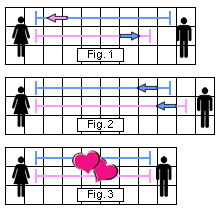 Yolanda is happy with the relationship, but she’s starting to want more. Her CD is starting to shrink, but she does not sense the same happening with Howard. So she begins to Pull (III) on Howard’s CD, dropping hints about rings and babies and puppies. She begins buying toothbrushes and storing them in random nooks of Howard’s house. Howard notices this behavior, and subconsciously begins to push back, trying to lengthen Yolanda’s CD to match his own. He stops returning her calls as quickly and leaves copies of Playboy out in his bathroom. (See Fig. 1.)
But then something strange happens. Yolanda gets hit with a big case at work. Although her feelings about Howard do not change, her time available for him does. Their dinners dwindle to once a week—her only free night. They stop seeing movies together. Howard’s bottle of Fire Engine Red crusts shut from disuse. Yolanda’s Schedule (II.1.b) has changed her CD, and he now finds himself the vulnerable one. He tries Pulling, sending her flowers and giving her foot massages. (See Fig. 2)
Yolanda’s big case lasts several months. She enjoys Howard’s extra attention but can’t find the time to give him what he needs. But over time, Howard’s CD slowly changes (I.1). By the time Yolanda’s case ends, Howard’s CD is the same that Yolanda’s was before the case. And since her CD never really changed—it just appeared to do so to Howard—when the case ends their two CDs match, putting them in blissful CD Equilibrium (I) (Fig. 3).
See Also:
Girls Are Geeks, Too
Why Chicks Don't Dig the Singularity
Drugs and Sex and Susie Bright
When Lego Goes to War
Crucial Minutiae blog
i suppose this would apply to friendships as well. very insightful.
I would add:
III.b. The False Pull
When the person with the larger CD leverages the imbalance to manipulate his or her partner and gratify a wider ego deficiency. While interpreted as genuine affection by the starved partner, this is really rooted in resentment and frustration.
Example: The girlfriend has met someone else and wants very much to start a relationship, but she knows she can never live with herself if she breaks the boyfriend’s heart, so, almost out of spite, she begins tending to his every need.
This article should be titled, “How to Waste 15 Minutes of Your Life!!” This is over rationalized garbage about how relationships are made. Howard and Yolanda should kill themselves. Wait, change their names and then kill each other – Yolanda? -wtf? I also don’t think a “constant distance” has the ability to change i.e. it is “constant” and not “dynamic”. No wonder you never get a girl, you’re a fucking retard.
I’ll just have you know that the author which you refer to as ‘this fucking retard’ has a great girlfriend and they have been together for quite a long time. And obviously it was a guy that wrote that stupid response as any girl that I know would wholeheartedly agree with this piece.
Ok, great article. I’m a guy , and also agree. The only question that comes to my mind would be:
Why the fucking fuck can’t people just speak straight???
I mean, why the “Pushes” and “Pulls”??? Aint it easier to just say, clearly and openly “Dude, I dont want to be with you anymore”?
I’ll never understand people that cannot speak plain and directly… what do they fear?